Why Is In-House RTM Billing Becoming the Safer Bet for PT Clinics?
Why Is In-House RTM Billing Becoming the Safer Bet for PT Clinics?
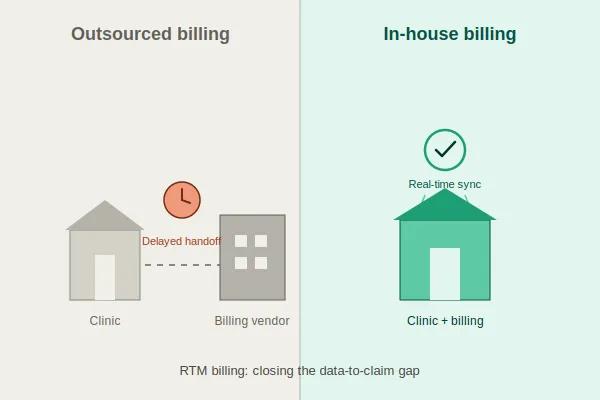
In-house RTM billing solves the workflow gap that most outsourced billing models can't: the real-time handoff between a clinician's monitoring documentation and the actual claim submission. As RTM billing rules get more granular and payer scrutiny increases, that handoff gap is exactly where outsourced models are most exposed — and it's a big reason more clinics are reconsidering the outsourced model heading into 2027.
The core problem: the documentation-to-claim gap
RTM billing (CPT codes 98975–98981, 98977, 98985) isn't like standard visit billing. It depends on day counts, device data transmission windows, time thresholds, and modifiers that change month to month for the same patient.
When billing is outsourced, there's almost always a lag between:
The clinical team logging monitoring data and time spent, and
The billing vendor translating that into a compliant claim.
That lag is where errors creep in — missed thresholds, wrong modifiers, claims submitted before (or after) the qualifying window closes. Outsourced vendors are built for volume and standardization, not for the day-by-day judgment calls RTM billing requires.
Why outsourced billing struggles specifically with RTM
Traditional RCM (revenue cycle management) outsourcing was built around high-volume, repeatable claim types — office visits, standard procedures, predictable coding. RTM billing breaks that model in three ways:
It's data-dependent, not visit-dependent. The claim depends on device transmission data the vendor doesn't generate or directly see in real time.
Thresholds are per-patient, per-30-day-period. A vendor managing hundreds of clinics can't easily track each patient's individual day count against 98977 vs. 98985 eligibility.
Documentation and billing are two different systems. If the clinical notes live in one platform and the billing vendor works from another, someone has to manually reconcile them — and that's where things get missed.
Why in-house billing closes the gap
When billing sits inside the clinic (or inside a platform built to unify monitoring and billing), the same team — or the same connected system — sees the data the moment it's generated. That means:
Day counts and thresholds are tracked automatically against the same record the clinician is using.
Modifier requirements (CQ/CO) are applied at the source, not reconstructed later.
Claims go out closer to real time, reducing the window for a threshold to lapse or a code to be misapplied.
This isn't about outsourced billers being careless — it's a structural mismatch between how outsourced RCM is built (standardized, volume-first) and what RTM billing actually requires (patient-specific, data-first, day-by-day).
Frequently asked questions
Q: Is outsourced RTM billing non-compliant? A: Not inherently — but the handoff between clinical documentation and claim submission creates more opportunities for threshold and modifier errors than an integrated, in-house workflow.
Q: What's the single biggest risk with outsourced RTM billing? A: Timing. RTM codes depend on per-patient day counts within a 30-day window, and any lag between data capture and claim submission increases the chance of billing the wrong code or missing the window entirely.
Q: Does in-house billing mean hiring a dedicated biller? A: Not necessarily — it can mean an integrated platform where monitoring data and billing logic live in the same system, so the "in-house" advantage comes from unified data, not headcount alone.
Q: Will outsourced RTM billing become non-viable? A: No. Outsourcing the Billing does not equal outsourcing the clinical services.
Want to see how integrated RTM billing works in practice? Schedule a demo with SaRA Health to see how monitoring data and billing logic stay in sync automatically.
