Why a "Uniform" RTM Cut Isn't Uniform for Rural Practices
Why a "Uniform" RTM Cut Isn't Uniform for Rural Practices
A physical therapy practice in western Nebraska has been running an RTM program for two years. It works. Patients text in their home exercise adherence, the practice catches drop-off before a patient disengages entirely, and the billing has become routine.
Then the CY 2027 Medicare Physician Fee Schedule proposed rule lands, and the practice manager runs the numbers. The cut looks small on paper. It is not small in practice. It is the difference between a program that pays for itself and one that quietly starts losing money every month.
That is the story worth telling before the comment period closes, because it is not really about RTM. It is about how a rule written to be uniform lands very differently depending on where a practice sits on the map.
The rule (CMS-1848-P) in brief
CMS published the CY 2027 Physician Fee Schedule proposed rule (CMS-1848-P) on July 14, 2026. Among the changes under consideration are revised practice expense inputs for the RTM setup and device supply codes (98975, 98976, 98977, 98978, 98984, 98985), based on CMS's view that device costs have come down since the current rates were set, or that CMS does not know/understand what pricing typically looks like.
Comments on the proposed rule are due September 14, 2026.
Why the same percentage cut is not the same cut
Medicare reimbursement is geographically adjusted. Every RTM code's RVUs are multiplied by a locality-specific Geographic Practice Cost Index before the conversion factor is applied. A clinic in a low-GPCI rural locality is already paid less for the identical code than a clinic in a high-GPCI metro area like Manhattan or San Francisco. That is by design. It reflects real differences in the cost of running a practice in different places.
The technology side of an RTM program does not work that way. A remote monitoring platform license, the patient engagement tools, staff training, and compliance overhead are, typically, priced nationally and flat. The rural clinic pays the same per-provider or per-patient rate as the urban clinic.
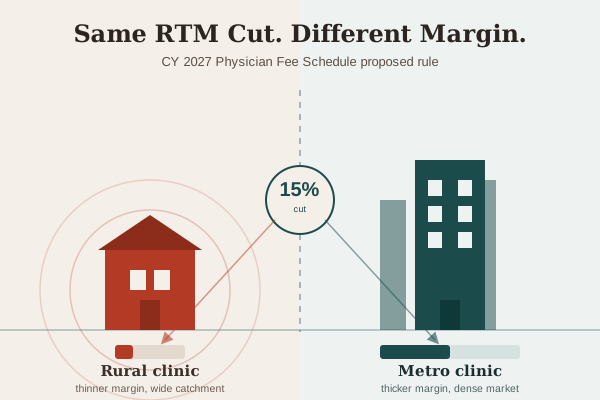
Put those two facts together and the margin on an RTM program, reimbursement minus fixed technology cost, is already structurally thinner in low-GPCI markets before CMS changes anything. A flat percentage reduction does not consume the same share of a thin margin and a thick one. It takes a much bigger bite out of the thin one, and in the lowest-GPCI localities it can erase the margin entirely.
A worked example (illustrative, not actual CMS figures)
Say a clinic's RTM reimbursement per enrolled patient per month, after GPCI adjustment, nets out to $40 in a high-GPCI metro locality and $28 in a low-GPCI rural locality, reflecting the geographic difference already built into current rates. Say the flat technology cost per patient is $18 a month in both places, because the software vendor does not adjust price by geography.
That leaves a $22 margin in the metro clinic and a $10 margin in the rural clinic, before any rule change. A 15 percent reduction in reimbursement removes $6 from the metro clinic's margin, leaving $16. The same 15 percent removes $4.20 from the rural clinic's margin, leaving $5.80. The percentage cut was identical. The share of margin it consumed was not, and the rural clinic is left with roughly a third of the cushion it started with.
Breakeven is a patient-count problem. Fixed practice costs for running the program divide by per-patient margin to determine how many enrolled patients justify the program. Cut the per-patient margin and that number goes up. Rural practices are the ones with the smallest patient panels to spread that fixed cost across, so the threshold rises exactly where it is hardest to clear.
The factors that compound it
A few things make this worse for rural independent practices specifically, not as a matter of complaint but as a matter of arithmetic:
A higher share of rural patient panels are Medicare beneficiaries, so a Medicare-specific rate change moves a larger portion of total revenue.
Overall operating margins tend to run thinner in rural independent practices to begin with.
Administrative staffing to run a monitoring program is leaner, so there is less room to absorb the change by working around it.
Many rural PT, OT, and speech practices are the only outpatient therapy option for a wide catchment area, with fewer other service lines to offset a loss on any one of them.
Where this connects to the initiating visit proposal
The proposed requirement for a separately reportable initiating visit before RTM begins raises a related concern. An additional required in-person or telehealth touchpoint adds the most burden for patients who already travel the farthest to reach a clinic. The patients for whom that extra visit is hardest to schedule are often the same patients RTM was built to help.
The access argument
This is where the policy conversation should end up. Remote monitoring does the most work for patients who cannot easily get to a clinic: long drive times, fewer visits possible per episode of care, and Health Professional Shortage Area or Medically Underserved Area geography. RTM is one of the few tools that partially closes that gap between visits.
A payment change that makes RTM uneconomical in rural markets does not remove the tool evenly. It removes it from the practices and patients who rely on it most, while leaving it fully intact in dense urban markets where alternatives are more plentiful. A rule intended to be geographically neutral ends up widening a geographic access gap.
None of this argues against the broader CY 2027 rule, and much of it reflects reasonable goals CMS is pursuing elsewhere in the same proposal. The specific concern is narrower: the RTM valuation changes, applied as a flat percentage, do not account for the geographic cost structure CMS itself already built into the reimbursement side.
What to do before September 14
CMS accepts public comments on proposed rules, and the RTM valuation provisions are exactly the kind of specific, well-supported concern that comment letters can influence. If your practice runs an RTM program and you have real numbers on your own margin and patient panel, that is the most persuasive thing you can submit.
SaRA has a comment letter template available for practice owners who want to weigh in before the deadline. Reach out to your account team to get a copy.
