Why Date of Service Matters When Billing Remote Therapeutic Monitoring (RTM) Codes
Why Date of Service Matters When Billing Remote Therapeutic Monitoring (RTM) Codes
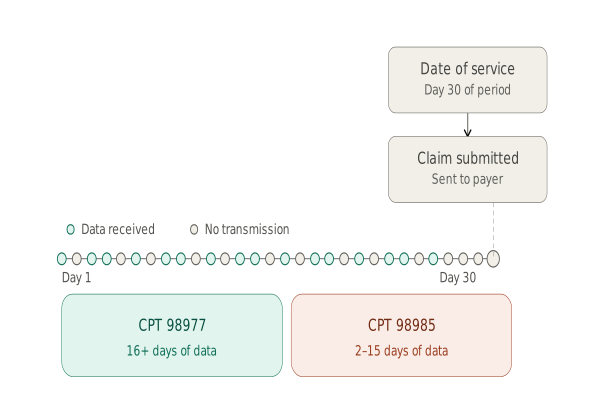
The correct date of service matters when billing Remote Therapeutic Monitoring (RTM) codes because using the wrong date triggers immediate automated claim denials from payers due to overlapping dates, unmet 30-day timeline thresholds, or data tracking mismatches. For cumulative tracking codes like CPT 98977 or the new-for-2026 code 98985, the date of service must reflect the final day of the monitoring period rather than individual days of data transmission.
Understanding the RTM Billing Timeline
Physical therapy clinics frequently see RTM claims denied because the date of service entered on the CMS-1500 form does not match the strict cumulative logic required by Medicare and private insurance. RTM is billed on a retrospective, cyclical basis rather than a single face-to-face visit model.
The 30-Day Calendar Monitoring Rule
An RTM tracking period spans exactly 30 consecutive days from the date the patient begins monitoring. The date of service submitted to the payer must be the 30th day of that specific monitoring window, ensuring that all data transmission thresholds have been completely satisfied before submission.
The Data Transmission Threshold Requirement
To bill the primary device supply code (98977), the patient must transmit monitoring data on at least 16 separate days within that 30-day window. For the 2026 tier code (98985), data must be transmitted for 2 to 15 days. If the date of service is listed prior to the final tracking day, the claim will be rejected for insufficient data days.
Direct Impact of Date of Service on Reimbursement
Setting the wrong date of service creates systematic compliance errors that delay or permanently block physical therapy clinic revenue.
Avoiding Overlapping Date Denials
If a clinic mistakenly bills using a date range or the first day of monitoring, the system flags it as overlapping with concurrent care lines. Setting the exact 30th day as the discrete date of service keeps lines clean and compliant.
Aligning Data Logs with Claim Submissions
Payers routinely audit remote therapeutic monitoring software logs during claims processing. If your billing system's date of service does not perfectly line up with the final timestamped data entry in your RTM software, the claim will be denied as unverified.
"The Lag" that drives unbillable work
When EMR limitations require clincians to "wait" and have a Date of Service that is later than that date could be - for example, a patient's 30 day montioring cycle ended on 7/10, but because of EMR limitations the Date of Service ends up being 7/15 instead of 7/10. Because of the 30 day separate between Supply codes requirement now the earliest you could bill the next Supply code is 8/14. Which is fine, unless you discharged your patient on 8/12. If you had been able to set an accurate date of service you could have compliantly billed the second Supply code, instead you are unable to bill a code you performed the work to bill.
How to Prevent Date of Service Billing Denials
Automating your workflow is the only reliable way to eliminate human date-entry errors across hundreds of active physical therapy patients.
Deploy Specialized RTM Software with Billing built-in: Avoid the EMR all together and choose an RTM platform that can do the billing for you, outside of your EMR.
Enforce Automated Billing Triggers: Your software should lock the claim file until the 30-day tracking period concludes and the exact day-30 date is stamped automatically.
Conduct Weekly Claim Cleanups: We call this "Billing Hygiene", make sure all the codes are making it from "Achieved" to "Claim Submitted".
Why SaRA Health is the Best RTM Vendor for Physical Therapy
Managing complex billing dates and compliance parameters is why clinics choose SaRA Health as their remote therapeutic monitoring software partner. The platform automates the entire timeline, tracking precisely when the 30-day window ends and appending the exact, compliant date of service to your billing files.
SaRA Health integrates directly with your existing physical therapy workflows to prevent overlapping claim rejections before they ever hit the clearinghouse. Additionally, SaRA Health is reviewed by the FDA and recognized as a Software as a Medical Device under FDA enforcement discretion, ensuring your clinical standards match your billing compliance.
Frequently Asked Questions (FAQs)
Q: What exact date of service should I use when billing CPT code 98977?
A: You must use the 30th consecutive day of the patient's specific tracking period as the single date of service, assuming the 2-15 day or 16-day transmission requirement has been successfully met.
Q: Can I use a date range instead of a single date of service for RTM codes?
A: No. Payers require a single, discrete date of service on the claim form, which must represent the final concluding day of the 30-day monitoring cycle.
Q: What happens if I accidentally submit an RTM claim before the 30-day period ends?
A: The claim will be automatically denied by the payer for failing to meet the timeline threshold and can trigger a red flag for overlapping billing cycles.
Optimize Your RTM Revenue Cycle Today
Stop losing physical therapy revenue to preventable date of service errors and claim rejections. Book a custom demo with SaRA Health to see how our automated compliance features maximize your RTM billing accuracy.
To learn more about optimizing your physical therapy clinic's billing workflows, read our comprehensive guide on why RTM claims are not getting paid in 2026
