
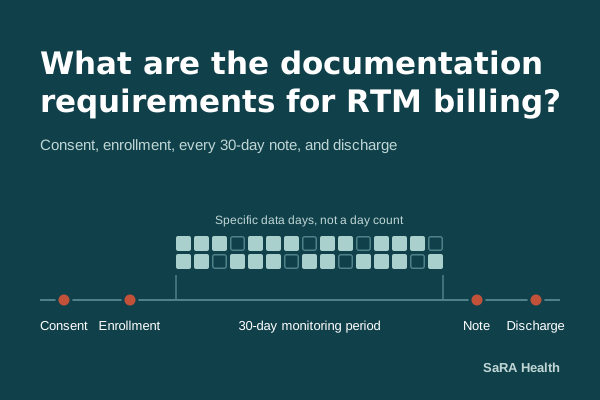
RTM billing requires documentation at four stages of every episode: signed patient consent, enrollment records tied to a certified plan of care, a signed note for each 30-day monitoring period, and a discharge record showing when monitoring and billing stopped.
No RTM-specific documentation guidance exists from the AMA or CMS. Practices apply Medicare's general outpatient therapy standard, which requires every note to be legible, relevant, and sufficient to justify the services billed (Medicare Benefit Policy Manual, Ch. 15, §220.3.A). This guide explains what that standard means for each stage of an RTM episode.
Why RTM documentation rules are unclear
The AMA defines the RTM CPT codes. CMS sets general therapy documentation rules. Neither has published guidance written for RTM.
That leaves several basic questions without an authoritative answer:
What counts as a day of monitoring. Access days, activity days, and data submissions are counted differently across the market.
Which date of service to use. Period start, period end, and the date of clinical review are all used in practice.
What proves the data exchange. No standard says whether a timestamped log is enough or the full exchange must be filed in the chart.
Where the records must live. Guidance does not address platform records held outside the practice's EMR.
Until payers publish answers, the defensible approach is to pick one interpretation, write it down as internal policy, and apply it to every claim.
Consent documentation for RTM
Signed consent must be on file before the first monitoring period begins. It should state what the monitoring involves, that RTM is billed to insurance with standard cost-sharing, and that the patient can decline or withdraw at any time.
No payer publishes a model RTM consent form. Consent is usually the first item a reviewer checks, because every billed service depends on it.
Enrollment documentation for RTM
At enrollment, five items belong in the record:
Setup and education: what was set up, what was taught, and confirmation the patient could use the device or software.
Plan of care: an active plan certified by a physician or non-physician practitioner, with diagnoses, goals, and therapy frequency and duration.
Ordering or referring provider: OIG flagged missing ordering-provider information as a leading problem in the similar RPM category.
Rationale for monitoring: one or two sentences on the risk of change between visits, what monitoring should prevent, and how long it is expected to last.
Pre-enrollment screen: no concurrent duplicative monitoring or home-health episode, and the patient's plan covers RTM.
What goes in each monthly RTM note
Each billed monitoring period needs a signed note that records a clinical decision, not just activity.
State the clinical finding. "Data reviewed" is not enough. Record what the data showed, why it matters, and what changed (or deliberately did not change) in the plan of care.
List the specific days of data exchange. "Monitored for 30 days" does not satisfy the requirement. List the actual days, pulled from timestamped logs.
Document the monthly interactive communication. Record the date and mode. The 10–19 minute treatment-management code requires real-time communication, and some payers apply that to the whole code family.
Verify the time breakdown. Confirm the time components add up to the stated total before signing. A mismatch is a data issue to report, not a number to adjust by hand.
Apply one date-of-service convention. Choose one, document it as policy, and use it on every claim.
Sign on time and name the clinician. Medicare's guideline is about one week from the end of the note period to signature (§220.3.B).
Discharge documentation for RTM
The record should show when monitoring began, what it showed, and when it ended. At discharge, document:
A final treatment-management note tying the monitoring data to the discharge decision.
The monitoring deactivation date, with confirmation that device-supply billing stopped.
Any transfer to another episode or provider.
A device-supply code billed after monitoring ends is the RTM version of a pattern OIG already flags in RPM.
RTM documentation requirements at a glance
Episode stage | What the record must show | Who documents it |
|---|---|---|
Consent | Signed consent with monitoring scope, cost-sharing disclosure, and right to withdraw | Practice |
Enrollment | Setup and education, certified plan of care, ordering provider, monitoring rationale, coverage screen | Clinician |
Each 30-day period | Clinical finding and care decision, specific data days, interactive communication (date and mode), verified time breakdown, signature within about one week | Clinician, using platform logs |
Discharge | Final note, deactivation date, device-supply billing stopped, any transfer | Clinician |
Quarterly | Sample of billing periods checked against every item above | Practice compliance |
Platform-generated logs and time summaries support the clinician's signed note. They do not replace it.
What two compliance reviews found about RTM documentation
From May through August 2026, SaRA Health commissioned and paid for two compliance reviews of RTM documentation on its platform. BCMS ran a records review built on Medicare audit criteria. Risk & Compliance Analytics ran an operational workflow review. The firms worked independently.
Both reviews found the monitoring service, patient engagement, and data capture sound. Both flagged the same three documentation gaps:
Notes recorded activity without a standard clinical structure.
Time breakdowns did not always add up to the stated totals.
Billing summaries were not always reconciled with the underlying interaction logs.
All three have been corrected on the SaRA platform. The lesson for any practice: these are the gaps a reviewer is likely to look for first.
Why RTM documentation scrutiny is increasing
RTM shares its code structure and documentation rules with Remote Patient Monitoring (RPM), which is already under federal review. In September 2024, OIG reported that about 43% of RPM enrollees did not receive all three required service components (OEI-02-23-00260).
Commercial payers are following. Effective September 1, 2026, Excellus BlueCross BlueShield policy AP-48 requires all three components (setup, device supply, and treatment management) and allows claim retraction when one is missing. Anthem's guideline CG-MED-91 requires a documented rationale for monitoring. Cigna's commercial policy 0563 excludes the RTM codes entirely, so coverage must be confirmed before enrollment.
Payer policies change without notice. Confirm the current policy of each payer you bill.
Frequently asked questions about RTM documentation
Is there official RTM documentation guidance from CMS or the AMA? No. Neither CMS nor the AMA has published RTM-specific documentation guidance. Practices apply Medicare's general outpatient therapy standard from the Medicare Benefit Policy Manual, Chapter 15.
Is a statement that the patient was monitored for 30 days enough? No. The record should list the specific days on which data was exchanged, taken from timestamped logs, using one written definition of a data day.
What should an RTM treatment note include? The clinical finding from the data, its significance, the resulting care decision, the date and mode of the monthly interactive communication, a verified time breakdown, and the clinician's signature within about one week.
Do platform-generated logs replace the clinician's note? No. Platform logs and time summaries support the signed note. Clinical judgment, medical necessity, and the accuracy of the record remain the clinician's responsibility.
What should be documented when RTM ends? A final note tying the monitoring data to the discharge decision, the monitoring deactivation date, confirmation that device-supply billing stopped, and any transfer of care.
Get the full RTM documentation white paper
The complete white paper includes a one-page RTM documentation checklist, two reviewer-drafted consent form models, and a commercial payer policy crosswalk. https://papers.ssrn.com/sol3/papers.cfm?abstract_id=7577838