
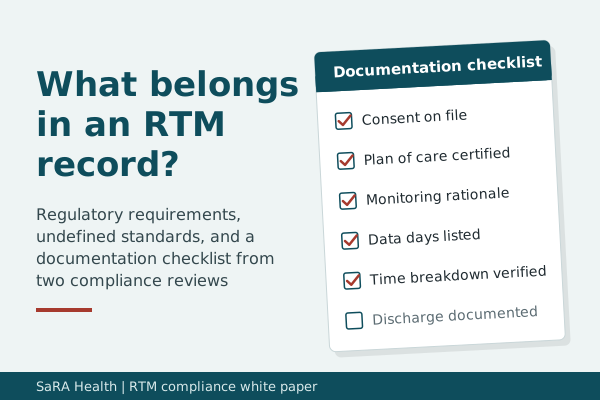
Remote Therapeutic Monitoring Documentation: Regulatory Requirements, Undefined Standards, and a Practice Guide Informed by Two Independent Compliance Reviews
Executive Summary
Remote Therapeutic Monitoring (RTM) is a reimbursable service category covering the monitoring and management of therapy patients between visits through non-physiologic data. Neither the American Medical Association, which defines the RTM CPT codes, nor the Centers for Medicare & Medicaid Services (CMS) has published RTM-specific documentation guidance. Practices billing these codes apply Medicare's general outpatient therapy documentation standards to a service model those standards predate.
From May through August 2026, SaRA Health commissioned two independent compliance reviews of the RTM documentation and billing workflows on its platform: a records review structured around Medicare Benefit Policy Manual audit criteria, and an operational workflow review conducted across active practices. Both reviews found the underlying monitoring service, patient engagement, and data capture sound. Both identified the same set of correctable documentation deficiencies, which have since been corrected, and both identified documentation questions that no current guidance answers; Section 5 presents those as areas requiring payer-level standardization.
This paper describes the regulatory framework governing RTM documentation, summarizes the reviews and their outcome, and then states what the record should contain at each stage of an RTM episode: consent, enrollment, each billed monitoring period, and discharge. Two reviewer-drafted consent forms are included as Exhibits A and B, so that practices can compare two approaches to the same requirements. Section 9 states the paper's limitations, including that SaRA Health commissioned and paid for the reviews of its own platform.
How to Use This Paper
This paper is a practice guide, not legal, coding, or billing advice. Sections 1 and 2 describe the regulatory framework and its open questions. Sections 3 through 5 report the two commissioned reviews and the standardization requests that followed. Sections 6 and 7 state what the record should contain at each stage of the patient episode, from consent through discharge, and who is responsible for documenting it, and Exhibit C condenses that guidance into a one-page checklist. The appendix maps published commercial payer requirements, as of September 2026, to the sections of this paper that address them. Payer and state requirements vary, so a practice should adapt the consent models, the note practices, and the checklist to its own payer mix and state requirements, in consultation with its compliance function or counsel.
1. Background: The RTM Service Category and Its Documentation Requirements
RTM permits a therapy practice to bill for reviewing non-physiologic data reported by or collected from the patient between visits, including musculoskeletal status, therapy adherence, therapy response, pain level, and functional status, and for the clinical decision-making that review informs. The service model corresponds to the episodic care outpatient rehabilitation already delivers, in which home programs, lifestyle modification, and patient self-management carry much of the therapeutic work between visits. In the patient records sampled by the reviews described in Section 3, message-based exchanges between patient and provider over a single episode of care ranged from dozens to several hundred.
The RTM code family covers three categories of work: initial setup and patient education; device supply and data transmission, billed in approximately 30-day periods; and treatment management, defined as clinician time spent reviewing data, responding to alerts, and adjusting care. Each category corresponds to specific CPT codes with defined time thresholds and billing frequency rules.
Category | Service covered | Documentation required |
|---|---|---|
Setup and education | Initial device/software onboarding and patient education, billed once per episode | What was set up, what was taught, and confirmation the patient could use the device |
Data transmission | The 30-day monitoring period: device supply and data exchange | The specific days on which data was exchanged, rather than a day count for the period |
Treatment management | Clinician time reviewing data, responding to alerts, and adjusting the plan of care | The clinical finding, the alert or trigger, and the resulting care decision |
Table 1. RTM service categories, simplified for orientation. Current CPT definitions, time thresholds, and payer-specific rules should be confirmed with the AMA and the relevant payer before billing.
The AMA has not published RTM-specific guidance on several questions that arise in routine billing: how to assign a date of service to a code that spans a 30-day window, what "total treatment time" includes, and what a compliant chart note contains. CMS guidance is similarly general. The Medicare Benefit Policy Manual establishes documentation standards for outpatient therapy as a whole and does not address RTM by code.
2. The Regulatory Framework and Its Undefined Areas
Medicare's baseline documentation standard requires that a treatment note be "legible, relevant, and sufficient to justify the services billed" (Medicare Benefit Policy Manual, Ch. 15, §220.3.A). Applied to RTM, this requires the record to identify the specific intervention or data reviewed, state total treatment time with a component breakdown, connect the service to an active plan of care, and carry a timely signature (§220.3.E).
Above that baseline, RTM is governed by a patchwork of authorities. AMA/CPT defines the codes. Chapter 15 defines therapy documentation generally, and predates RTM; it does not contemplate platform-generated records. Medicare Administrative Contractors issue local interpretations. Commercial payers publish limited RTM policy, and published policies vary between payers and from Medicare. As a result, several questions that a compliance officer would treat as basic have no authoritative published answer.
Undefined area | Consequence for providers |
|---|---|
Definition of a "day of monitoring" | Patient access days, activity days, and discrete data submissions are counted differently across the market; no payer publishes a binding definition. In this paper, a "data day" means a calendar day on which the patient exchanged monitoring data with the practice's system, with multiple same-day exchanges counted once. |
Date of service | Period start, period end, and date of clinical review are each used in practice; no single accepted convention exists. |
Evidentiary standard for the data exchange | No published standard states whether a timestamped log satisfies the record requirement or whether the full patient exchange must be filed in the chart. |
Location of documentation | Guidance requires the medical record to justify the service and does not address platform-generated records held outside the treating provider's EMR. |
Commercial payer policy | Coverage and documentation expectations vary by payer, and many payers publish no RTM policy. |
Table 2. Undefined documentation areas and their consequences. Each determines whether a claim is payable and whether a record withstands review.
In the absence of published standards, practices resolve these questions through internal policy or vendor defaults. Either approach is defensible only to the extent that it is written down, consistently applied, and reviewed against new guidance as it appears.
These gaps cannot be closed by any vendor or any individual practice. Internal policy and vendor defaults can make an interpretation consistent and documented, but only payer-level guidance can make it authoritative. This paper accordingly reports the questions as open rather than resolving them; Section 5 states what SaRA Health has asked payers to publish.
One requirement in this framework is well defined, and it sits with the vendor. The RTM device-supply codes require a medical device as defined by section 201(h) of the Federal Food, Drug, and Cosmetic Act, and software alone can qualify under the FDA's Software as a Medical Device (SaMD) framework; no separate hardware is required. A vendor stating that its platform supports RTM billing is therefore making a regulatory claim, and it should be able to produce documentation supporting that claim, such as an FDA 513(g) classification determination, device registration and listing, or a clearance where one applies. A practice evaluating an RTM platform should request that documentation in writing before billing device-supply codes through it, because in a payer review the billing provider, not the vendor, answers for the claim. SaRA Health's platform classification is documented through the FDA 513(g) process referenced in Section 7.
3. Review Methodology
In May 2026, SaRA Health commissioned two compliance reviews of the RTM documentation and billing workflows on its platform; the reviews ran through August 2026.
The first, conducted by BCMS under the direction of Jody Swearingen, was a records review structured around Medicare Benefit Policy Manual audit criteria, covering two practices with 8 total patients and 30 claims. The second, conducted by Risk & Compliance Analytics under the direction of Daniel Hirsch, was an operational workflow review across active practices on the platform, covering two practices with 8 total patients covering 28 claims.
SaRA Health paid for both reviews; the participating practices did not. The firms worked independently, and neither had access to the other's findings during its review. Participating practices were asked to participate and were not incentivized to do so. The participating practices were chosen by SaRA leadership in order to capture each "flavor" of RTM in our customer base. For example, one practice was chosen because of their "Mission Control" approach, several were chosen because they do use the SaRA Health RTM billing service, and several were chosen because they do NOT use the SaRA Health RTM billing service. Additionally, geography and patient type were taken into account to include rural and urban, ortho and vestibular, geriatric and PEDS, etc.
4. Review Outcome
Both reviews reached the same baseline conclusion: the platform is technically sound, patient engagement is strong, and device data capture is reliable. Working independently and with different methods, both identified the same set of documentation deficiencies, principally in note standardization, treatment-time component breakdowns, and the reconciliation of billing summaries with underlying interaction logs. The convergence of two independent reviews on one list was treated as sufficient grounds to remediate all of it; Section 4.1 states each finding and its correction.
Both reviews also surfaced a second category of observations: points on which a reasonable auditor and a reasonable provider could disagree because no published guidance resolves them. The reviews treated these not as deficiencies but as open questions in the regulatory framework itself; they are presented in Section 5, and the documentation guidance in Section 6 is written to be defensible while they remain open.
4.1 Remediation
Two reviewers, working independently and with different methods, converged on one list of documentation deficiencies, and the corrections are stated below.
Finding identified by both reviews | Corrective action implemented | Status |
|---|---|---|
Treatment notes recorded activity without a standardized clinical structure | Standardized RTM note templates and audit-ready documentation prompts covering the data reviewed, the clinical interpretation, and how findings influenced care; chart notes now capture the patient's responses rather than only outbound messages (completed July 2026); consent language finalized with opt-out and financial-responsibility disclosure (completed September 2026) | Corrected, in production |
Treatment-time component breakdowns did not consistently sum to stated totals | Total treatment time is calculated from logged activity components, and clinician verification of the component sum before signing is the required workflow (Section 6.3) | Corrected, in production |
Billing summaries not consistently reconciled against underlying interaction logs | The billing justification's day count and its supporting day list are generated from a single source of record; failed inbound messages are excluded from data-day counts; the in-app justification window matches the full 30-day supply period (all completed August 2026) | Corrected, in production |
Table 3. Review findings and remediation status.
5. Areas Requiring Payer-Level Standardization
The open questions identified by both reviews (the evidentiary standard for the data exchange, the correct date of service for a monitoring-period claim, and the relationship between platform-held and EMR-held records) are questions of payer policy rather than of vendor or practice preference. A vendor answering them unilaterally would be substituting its own judgment for a standard that does not exist; a practice answering them alone assumes the same risk with fewer resources.
SaRA Health has asked payers, Medicare Administrative Contractors, professional associations, and other RTM platform vendors to converge on published standards in five areas:
A binding definition of a "monitoring day," applied consistently across the RTM code family.
A stated convention for the date of service on a monitoring-period claim.
A stated evidentiary standard for the data exchange: whether a timestamped log satisfies the record requirement or the full exchange must be filed in the chart.
Commercial payer RTM policies published in writing rather than communicated case by case.
Clarification of the interactive-communication requirement for the treatment-management codes: whether the required monthly interactive communication may be satisfied by an in-person interaction during a clinic visit or must occur remotely, whether real-time communication is required across the full code family or only 98979 or 98980, and how the interaction should be documented. Practices are already standardizing an in-clinic interaction to satisfy payer all-components requirements, and this paper specifically requests commentary from the AMA and CMS on whether that response is compliant.
Published standards would replace the current variance in interpretation with requirements that vendors and practices can build to and be measured against.
6. Documentation Through the Patient Episode
The documentation obligations of an RTM program follow the sequence of the episode itself. This section states what the record should contain at each stage: consent, enrollment, each billed monitoring period, and discharge. The guidance is drawn from the review findings, the Medicare Benefit Policy Manual provisions cited, OIG's published billing-integrity measures for the adjacent RPM category, and, where noted, published commercial payer policy. None of it requires new technology.
6.1 Consent
Before the first monitoring period begins, the record should contain the patient's consent to RTM. The consent documentation should state what the monitoring involves, the patient's financial responsibility (RTM services are billed to insurance, and standard cost-sharing applies), and the patient's right to decline or to withdraw at any time. No payer publishes a model RTM consent form. During the reviews described in Section 3, each firm independently revised SaRA Health's sample consent language, and both resulting documents are included in this paper: Exhibit A, a combined consent and waiver model drafted by Daniel Hirsch of Risk & Compliance Analytics, and Exhibit B, the consent revision drafted by Jody Swearingen of BCMS. Each exhibit is annotated to show why the form requests each data point. The two documents take different approaches to the same requirements, and either is a defensible starting point. A practice adopting one should have its compliance function adapt it to state and payer requirements before use. Consent is the first item an internal or external reviewer checks, because every subsequently billed service depends on it.
6.2 Enrollment
At enrollment, five items belong in the record. First, the setup-and-education service itself: what was set up, what the patient was taught, and confirmation that the patient could use the device or software (Table 1). Second, the plan of care: an active, physician- or non-physician-practitioner-certified plan establishing diagnoses, goals, and the type, amount, duration, and frequency of therapy (BPM Ch. 15, §§220.1.1–220.1.3). Every RTM service in the episode should trace to it. Third, the referring or ordering provider: OIG identified the absence of ordering-provider information as a leading RPM finding, and RTM should be expected to face the same scrutiny. Fourth, the rationale for monitoring: one or two sentences stating the risk of clinically significant change between visits given the condition's current status, why between-visit monitoring is needed, what deterioration or adverse events the monitoring is expected to prevent, and the anticipated duration of monitoring. Published commercial payer policies condition payment on exactly this rationale appearing in the clinical record, and at least one payer's documentation requirements include the anticipated length of monitoring (Section 8). Fifth, a pre-enrollment screen, noted in the record: no concurrent duplicative monitoring or home-health episode is underway, and the patient's plan covers RTM. At least one national commercial policy currently excludes the RTM codes for any indication, so coverage is confirmed before enrollment rather than documented after.
6.3 Each Monitoring Period: The Note
Record the clinical finding, not the activity. Entries such as "data reviewed" or "trends noted" record that an activity occurred without recording a clinical decision. The note should state what the data showed, its clinical significance, and what changed, or deliberately did not change, in the plan of care.
Document the specific days of data exchange. A statement that monitoring was performed for 30 days does not satisfy the data-transmission requirement. The record should list the days on which data was exchanged, sourced from timestamped logs, applying the data-day definition in Table 2 consistently.
Document the monthly interactive communication. The treatment-management codes require at least one interactive communication with the patient or caregiver during the calendar month, in real time for the 10 to 19 minute code, and some payers apply the real-time expectation to the full treatment-management family. The note should record the date and mode of that communication. Where a payer conditions payment on all service components being furnished, the documented interaction is the evidence that treatment management occurred (Section 8). Whether an in-person interaction during a clinic visit satisfies this requirement is not addressed in published guidance; Section 5 requests commentary from the AMA and CMS on exactly this question, and until it is answered the record should state the mode of the interaction so the claim can be defended under either reading.
Verify the time breakdown before signing. Where the platform calculates monitoring, provider-review, and patient-interactive minutes from logged activity, the clinician should confirm the components sum to the stated total before signing. A discrepancy indicates a data issue to report to the platform, not a figure to adjust manually.
Apply one date-of-service convention, in writing. Because no published convention exists (Table 2), the practice should adopt a single convention, document it as internal policy, and apply it to every monitoring-period claim.
Sign within the guideline and identify who furnished the service. Medicare's guideline is approximately one week from the end of the note period to signature (§220.3.B). The record should identify who furnished the monitoring and review, since RTM must be furnished by the billing provider or under that provider's appropriate supervision.
6.4 Ongoing: The Quarterly Self-Review
Each quarter, pull a sample of recent RTM billing periods and confirm, in episode order: consent on file with opt-out language and financial-responsibility disclosure; an active plan of care with certification or recertification where required; the ordering or referring provider documented; setup and education documented for new enrollments; the monitoring rationale and pre-enrollment screen documented; notes stating specific findings; time breakdowns that sum to stated totals; specific data-exchange days documented; the monthly interactive communication documented; the practice's date-of-service convention applied; the furnishing clinician identified; signatures within the one-week guideline; RTM documentation located in, or accessible from, the patient's primary medical record; and, for discharged patients, the discharge documentation described in Section 6.5. This checklist is adapted from OIG's RPM billing-integrity measures (OEI-02-23-00260; OEI-02-23-00261) and BPM Ch. 15, §§220.1.1–220.1.3 and §220.3.A–E. The checklist is presented in one-page form as Exhibit C for internal use.
For a new program, the first quarter follows the same sequence. Weeks 1–2: finalize consent language and plan-of-care documentation, and select the device and monitoring workflow. Weeks 3–4: enroll a pilot group and document consent, setup, and education to the standards above. Weeks 5–8: complete the first full monitoring and treatment-management cycle, reconciling time entries before each note is signed. Weeks 9–12: apply the quarterly checklist to the pilot's first complete billing cycle before scaling enrollment. The purpose of the pilot period is to correct documentation habits while the enrolled population is small.
6.5 Discharge
The episode record should show when monitoring began, what it showed, and when it ended. At discharge, three items complete the record. First, the final treatment-management note: it ties the episode's monitoring data to the discharge decision and disposition, whether goals were met, therapy was discontinued, the patient withdrew, or care transferred. Second, the monitoring deactivation date, with confirmation that device-supply billing stopped with deactivation. OIG lists device charges without treatment management among its RPM billing-integrity measures, and a device-supply code billed after monitoring has ended is the RTM equivalent of that pattern. Third, any transfer to another episode or provider, documented so the next record begins where this one ends. At least one payer now defines the remote monitoring episode of care as ending with attainment of targeted treatment goals and states that remote monitoring is not intended to be an ongoing service (Section 8), which makes a documented endpoint part of the billing record rather than a formality.
7. Division of Documentation Responsibility Between Platform and Clinician
RTM documentation responsibility is divided between the monitoring platform and the treating clinician. A practice evaluating any RTM vendor should require a written statement of where that division sits, and documentation of the platform's status as a medical device (Section 2). On the SaRA platform, the division is as follows.
Generated automatically by the platform: timestamped interaction and message logs; data-day and monitoring-period summaries used for billing justification; billing-code eligibility flags when monitoring thresholds are met; total treatment time, calculated and broken into components from logged activity; and the one-time FDA 513(g) device-classification disclosure.
Provided by the platform as templates: sample RTM consent language for adaptation by the practice's compliance function (two reviewer-drafted models are included as Exhibits A and B), and structured note prompts for common RTM scenarios (in active development; current availability should be confirmed with the practice's account team). Worked documentation examples for each RTM code are planned.
Documented by the treating clinician: the specific clinical finding or data interpretation for the period and the care decision made in response; the connection to the patient's plan of care and the goal the service supports; physician or non-physician practitioner certification and recertification of that plan; and the signature, within the one-week guideline, after confirming that the platform-generated time and data-day figures are accurate for the period.
Platform-generated figures are inputs to the clinician's review, not substitutes for it. Platform-generated logs and summaries support the clinician's signed note; they do not replace it. Clinical judgment, medical necessity, and the accuracy of the signed record remain the clinician's responsibility under existing guidance.
8. Regulatory Outlook
RTM shares its regulatory framework, code structure, and documentation requirements with Remote Patient Monitoring (RPM), which is already the subject of active federal oversight. In September 2024, OIG reported that approximately 43% of RPM enrollees did not receive all three required service components, and that Medicare claims data does not capture who ordered the monitoring or what type of health data was collected (OEI-02-23-00260). An August 2025 data snapshot reported RPM payments of $536 million in 2024, a 31% increase over 2023, together with billing patterns OIG identified as possible indicators of fraud, waste, and abuse, including sudden enrollment increases and enrollees who received device supply without treatment management (OEI-02-23-00261).
The relevance of these RPM findings to RTM is structural rather than speculative. The two code families share their architecture, their documentation predicates, and their Medicare Administrative Contractors, and the deficiencies OIG has flagged in RPM, missing ordering-provider information and service components not furnished, correspond to documentation elements an RTM practice controls today. It is reasonable to expect RTM review to follow the RPM template, and a practice documenting to Section 6 will already hold the records such a review requests.
Commercial payers have begun converting these oversight concerns into payment policy. Effective September 1, 2026, Excellus BlueCross BlueShield's administrative policy AP-48 (Remote Monitoring) requires all three remote monitoring components (setup, device supply, and treatment management) to be performed, and states that when the three components are not billed the plan may retract claims and deny all remote monitoring services, under both pre-payment and post-payment review. The same policy defines the remote monitoring episode of care as ending with attainment of targeted treatment goals, states that remote monitoring is not intended to be an ongoing service, requires the order to state the condition and the anticipated length of monitoring, and cites OIG's RPM report among its references. A payer enforcing the all-components structure through retraction makes the episode documentation described in Section 6, from the enrollment rationale through the discharge record, the practical defense. The appendix maps this and other published commercial policies to the sections of this paper that address them.
CMS has proposed significant RTM-specific changes for calendar year 2027 in the Calendar Year 2027 Physician Fee Schedule Proposed Rule (CMS-1848-P, published July 14, 2026). As of this writing the rule is a proposal only; CMS may revise or decline to adopt any provision after reviewing public comments, which were due September 14, 2026. This paper does not analyze the proposal in detail and will be updated as the rule moves toward finalization. The direction of these developments is consistent: oversight is tightening around a documentation standard that has not been fully published. Practices that document each episode as described in Section 6 position themselves for that standard however the final rule resolves.
9. Limitations
This paper reports the results of compliance reviews that SaRA Health commissioned, and paid for, of its own platform and workflows. The reviewing firms were engaged and compensated by SaRA Health. The outcome summary in Section 4 is drawn from the reviewing firms' reports and has not been independently verified by a third party. Findings reflect the records and practices sampled during the review period stated in Section 3 and may not generalize to other platforms, practices, or periods. The CY 2027 proposed rule discussed in Section 8 is not final and may change. The payer policies summarized in the appendix reflect documents available as of September 2026 and change without notice; the current policy of each payer controls. This paper is educational; it is not legal, coding, or billing advice, and current code definitions and payer rules should be confirmed with the AMA, CMS, and the relevant payer before billing.
10. Conclusion
RTM's documentation requirements are governed by general standards that predate the service category, supplemented by local and payer-specific interpretation. Two independent reviews of one platform's implementation found the monitoring service itself sound, identified a consistent set of correctable documentation deficiencies that have since been addressed, and confirmed that several basic documentation questions remain unanswered by any published authority. Those questions require payer-level standardization, as outlined in Section 5. Until that standardization occurs, documenting each episode as described in Section 6, from consent through enrollment through each billed monitoring period through discharge, represents a defensible implementation of existing guidance.
About SaRA Health
SaRA Health provides remote therapeutic monitoring software and billing services to outpatient physical, occupational, and speech therapy practices. Inquiries regarding this paper may be directed to Steven Coen steven@sarahealth.com.
Exhibit A: Consent and Waiver Model (Risk & Compliance Analytics)
Source: "Compliance Enhanced SaRa Sample recommended Consent form," drafted by Daniel Hirsch, Risk & Compliance Analytics, July 1, 2026, as a revision of SaRA Health's sample consent language, combining consent and waiver language in a single document.
EXHIBIT A · CONSENT AND WAIVER MODEL · PART 1 OF 2
Remote Therapeutic Monitoring Consent: annotated to show why each element is requested
Form drafted by Daniel Hirsch, PT, DPT, CHA, OHCC, COCAS (Risk & Compliance Analytics), July 1, 2026, as a revision of SaRA Health's sample consent language. Form text reproduced verbatim; numbered annotations added by SaRA Health.
OUR PHYSICAL THERAPY EXPERIENCE
At COMPANY NAME, we understand that both your clinical care and your efforts outside of the clinic are important to your progress and recovery.
To support your treatment plan, we offer the COMPANY Experience, which includes Remote Therapeutic Monitoring ("RTM") services designed to help facilitate communication between you and your therapy team between visits.
Participation in RTM services is voluntary and intended to supplement, not replace, your in-person care and professional medical judgment. 1
HOW WE'RE DIFFERENT
The COMPANY Experience enables communication with you through secure electronic communications, including text messaging.
As part of your participation, we may communicate with you regarding: 2
- Your symptoms and functional status;
- Your home exercise program and treatment recommendations;
- Educational information related to your condition;
- Questions regarding your progress and recovery;
- Appointment reminders and administrative information necessary to support your care.
Your participation and responses may assist your therapist in monitoring your progress and making clinically appropriate adjustments to your treatment plan between visits. RTM services are not intended for emergency medical situations or urgent medical needs.
YOUR CARE BEYOND THE CLINIC
This service is intended to facilitate communication and support your treatment plan when you are not physically present in the clinic.
RTM services are designed to promote patient engagement, improve communication between visits, and assist your therapy team in supporting your treatment goals.
Coverage for Remote Therapeutic Monitoring services varies by payer and individual benefit plan and cannot be guaranteed. 3
Deductibles, copayments, coinsurance, and non-covered services may result in out-of-pocket expenses for which you may be financially responsible.
REMOTE THERAPEUTIC MONITORING AND ELECTRONIC COMMUNICATION CONSENT
By signing below, I voluntarily consent to participate in the COMPANY Experience and authorize COMPANY NAME to communicate with me electronically, including by text message, regarding my treatment and participation in Remote Therapeutic Monitoring services. 4
I understand and acknowledge that:
Electronic Communications 5
- Message frequency may vary depending upon my clinical needs and participation.
- Standard messaging and data charges may apply according to my mobile service plan.
- I am responsible for maintaining an accurate mobile phone number and notifying COMPANY NAME if my contact information changes.
HIPAA and Privacy 6
- Information exchanged through RTM services may include Protected Health Information ("PHI") as defined by applicable federal and state privacy laws.
- I authorize COMPANY NAME and its workforce members, agents, contractors, and business associates, as permitted by law, to collect, receive, use, maintain, transmit, and disclose my information as reasonably necessary for: treatment; payment; healthcare operations; clinical documentation; administration of RTM services; quality assessment and performance improvement activities permitted by law; compliance with applicable legal and regulatory requirements.
- COMPANY NAME maintains administrative, physical, and technical safeguards designed to protect the confidentiality and security of my information.
Risks of Electronic Communications 7
I understand that electronic communications involve inherent risks, including:
- Unauthorized access to information stored on my mobile device;
- Delays in transmission or delivery failures;
- Accidental disclosure to individuals who may have access to my device;
- Technological limitations that may affect confidentiality or delivery.
I acknowledge that no electronic communication system can guarantee absolute security.
Why each element is here
Each number explains the regulatory purpose of the item it marks. BPM = Medicare Benefit Policy Manual, Ch. 15.
Continued on Part 2: Voluntary Participation, Emergency Situations, Financial Responsibility, Patient Acknowledgment, and signature blocks.
EXHIBIT A · CONSENT AND WAIVER MODEL · PART 2 OF 2
Remote Therapeutic Monitoring Consent: annotated to show why each element is requested
Form drafted by Daniel Hirsch, PT, DPT, CHA, OHCC, COCAS (Risk & Compliance Analytics), July 1, 2026, as a revision of SaRA Health's sample consent language. Form text reproduced verbatim; numbered annotations added by SaRA Health.
Voluntary Participation 8
- Participation in RTM services is voluntary.
- I may decline participation without affecting my right to receive medically necessary physical therapy services.
- I may revoke my consent to participate and receive electronic communications at any time by notifying COMPANY NAME in writing. Revocation will not affect actions already taken in reliance upon this authorization.
Emergency Situations 9
I understand that RTM communications and text messages are not intended for emergency medical situations or urgent medical needs. In the event of an emergency, I will call 911, contact my physician, or seek appropriate emergency medical care.
Financial Responsibility 10
I understand that RTM services may be billed to my insurance carrier when medically necessary and appropriately documented. Insurance coverage and payment cannot be guaranteed, and I may be financially responsible for applicable deductibles, copayments, coinsurance, and non-covered services.
By providing my mobile telephone number, I represent that I am the subscriber or customary user of that number and consent to receive communications regarding my care and participation in RTM services at that number. 11
PATIENT ACKNOWLEDGMENT 12
By signing below, I acknowledge that:
☐ I have read and understand this Agreement.
☐ I have had the opportunity to ask questions and have received satisfactory answers.
☐ I voluntarily consent to participate in Remote Therapeutic Monitoring services.
☐ I authorize electronic communications, including text messaging, related to my treatment and participation in RTM services.
☐ I understand that information transmitted through RTM services may include Protected Health Information and will be handled in accordance with applicable privacy laws.
☐ I understand that insurance coverage and payment cannot be guaranteed and that I may incur financial responsibility for certain services.
☐ I understand that I may revoke this consent at any time by notifying COMPANY NAME in writing.
Cell Phone Number:
Patient Name:
Patient Signature:
Date:
If signed by a personal representative: 13
Representative Name:
Relationship to Patient:
Representative Signature:
Date:
Why each element is here (continued)
Each number explains the regulatory purpose of the item it marks. BPM = Medicare Benefit Policy Manual, Ch. 15.
Exhibit A to "Remote Therapeutic Monitoring Documentation: Regulatory Requirements, Undefined Standards, and a Practice Guide Informed by Two Independent Compliance Reviews" (SaRA Health, draft). The form text above is the reviewer's work product, reproduced with permission [CONFIRM before publication]. Annotations are SaRA Health's interpretation and are educational, not legal advice. COMPANY NAME is a placeholder for the adopting practice's name; practices should adapt the form to state and payer requirements before use.
Exhibit B: Consent Revision Model (BCMS)
Source: "SaRA Sample recommended Consent form, Revision by BCMS," drafted by Jody Swearingen, BCMS, dated July 6, 2026, as a revision of the same SaRA Health sample.
EXHIBIT B · CONSENT REVISION MODEL
Remote Therapeutic Monitoring Consent: annotated to show why each element is requested
Form drafted by Jody Swearingen, DPT, OCS, STC, COMT, CHP (BCMS), dated July 6, 2026, as a revision of SaRA Health's sample consent language. Form text reproduced verbatim; numbered annotations added by SaRA Health. Decorative graphics from the original omitted.
REMOTE THERAPEUTIC MONITORING (RTM)
CONSENT FORM
Patient Name: 1
1. Purpose of Remote Therapeutic Monitoring (RTM) 2
Remote Therapeutic Monitoring (RTM) allows our clinical team to monitor your progress, symptoms, adherence to your home exercise program, and response to treatment between in-person visits. This service helps us adjust your plan of care in a timely manner and improve your outcomes.
2. How RTM Communication Works 3
You will receive messages from our designated secure and FDA-reviewed RTM platform regarding your symptoms, function, home exercise program, and progress. You may respond to these messages via text.
Important Security Notice:
- Messages sent from the RTM platform to you are transmitted through a secure, encrypted system that meets HIPAA standards.
- However, when you reply using standard text messaging (SMS) from your personal phone, those responses are not encrypted and may be visible to your mobile carrier or others who have access to your phone.
- By participating in RTM, you acknowledge and accept the risks associated with unencrypted text messaging, including the potential for unauthorized access to your protected health information (PHI).
3. Authorization to Use and Disclose Protected Health Information (PHI) 4
I authorize and its clinical staff to send and receive my protected health information (PHI), including information about my symptoms, function, treatment adherence, and progress, through the RTM platform and text messaging for the purpose of providing Remote Therapeutic Monitoring services.
This authorization will expire upon completion of the RTM program, discharge from therapy services, or upon my written revocation, whichever occurs first.
4. Billing and Financial Responsibility 5
RTM services are billed to insurance on a monthly basis. Depending on your insurance plan, you may be responsible for:
- Deductibles
- Coinsurance
- Copayments
RTM services are billed in addition to your regular therapy visits. By signing this form, you acknowledge that you understand RTM is a billable service and that you may have out-of-pocket costs.
5. Opt-Out and Revocation of Consent 6
You may opt out of the RTM program or revoke this consent at any time by:
- Notifying your therapist or the front office in writing, or
- Replying "STOP" to RTM messages (this will end participation in the program)
Revoking consent will not affect your ability to continue receiving in-person therapy services.
6. Risks and Benefits 7
Benefits may include improved monitoring of your progress, faster adjustments to your treatment plan, and better overall outcomes.
Risks include the possibility that information sent via standard text messaging could be intercepted or accessed by unauthorized individuals due to the lack of encryption on personal SMS responses.
7. Patient Consent 8
I have read and understand this consent form. I have had the opportunity to ask questions, and all my questions have been answered to my satisfaction.
I voluntarily consent to participate in Remote Therapeutic Monitoring (RTM) services as described above. I understand the security limitations of standard text messaging and authorize the practice to communicate through this method for RTM purposes.
Patient / Representative Signature:
Date:
Printed Name:
Relationship to Patient (if applicable):
Cell Phone Number to be used for RTM Messaging: 9
Why each element is here
Each number explains the regulatory purpose of the item it marks.
Exhibit B to "Remote Therapeutic Monitoring Documentation: Regulatory Requirements, Undefined Standards, and a Practice Guide Informed by Two Independent Compliance Reviews" (SaRA Health, draft). The form text above is the reviewer's work product, reproduced with permission [CONFIRM before publication]. Annotations are SaRA Health's interpretation and are educational, not legal advice. is the form's merge placeholder for the adopting practice's name; practices should adapt the form to state and payer requirements before use.
Exhibit C: One-Page RTM Documentation Checklist
Drawn from Section 6. A practice may reproduce this page for internal use, adapted to its payer mix and state requirements.
At consent, before the first monitoring period
☐ Signed RTM consent on file, stating what the monitoring involves, the patient's financial responsibility and cost-sharing, and the right to decline or withdraw
☐ Consent locatable in, or accessible from, the patient's chart
At enrollment
☐ Setup and education documented: what was set up, what was taught, and confirmation the patient could use the device or software
☐ Active plan of care, certified by a physician or non-physician practitioner, establishing diagnoses, goals, and the type, amount, duration, and frequency of therapy
☐ Referring or ordering provider documented
☐ Rationale for monitoring documented, including the risk of change between visits and the anticipated duration of monitoring
☐ Pre-enrollment screen noted: no concurrent duplicative monitoring or home-health episode, and payer coverage of RTM confirmed
Each monitoring period, in the note
☐ Clinical finding stated, with its significance and the resulting care decision, or the deliberate decision not to change the plan
☐ Specific days of data exchange listed from timestamped logs, using one written data-day definition
☐ Monthly interactive communication documented, with date and mode
☐ Time breakdown verified: components sum to the stated total before signing
☐ The practice's written date-of-service convention applied
☐ Furnishing clinician identified, and signature within approximately one week of the note period's end
At discharge
☐ Final treatment-management note ties the episode's monitoring data to the discharge decision and disposition
☐ Monitoring deactivation date recorded, and device-supply billing stopped with deactivation
☐ Any transfer to another episode or provider documented
Quarterly
☐ Sample of recent RTM billing periods reviewed against every item above
☐ RTM documentation located in, or accessible from, the patient's primary medical record
☐ Vendor's medical-device (SaMD) documentation on file
☐ Payer policy and guidance changes reviewed, and internal policies updated
Sources: Medicare Benefit Policy Manual, Ch. 15, §§220.1.1–220.1.3 and §220.3.A–E; OIG reports OEI-02-23-00260 and OEI-02-23-00261.
Appendix: Commercial Payer Policy Crosswalk (September 2026)
This appendix summarizes the most stringent published commercial payer requirements for RTM located in a September 2026 review, and maps each requirement to the section of this paper that addresses it. Payer policies vary by plan and state and change without notice; this appendix is a snapshot, not a substitute for verifying the current policy of each payer billed.
Payer and policy | Position and key requirements |
|---|---|
Cigna commercial, Medical Coverage Policy 0563 (effective 5/15/2026) | RTM codes are not covered or reimbursable for any indication under the commercial policy. This is a benefits exclusion rather than a documentation standard; no record quality makes an excluded claim payable. Cigna Medicare Advantage follows Medicare rules. |
Excellus BlueCross BlueShield, Administrative Policy AP-48, Remote Monitoring (effective 9/1/2026) | All three remote monitoring components (setup, device supply, and treatment management) must be performed; when the three components are not billed, the plan may retract claims and deny all remote monitoring services, under pre-payment and post-payment review. The policy applies to all lines of business except the Federal Employee Program. It defines the episode of care as ending with attainment of targeted treatment goals, states that remote monitoring is not intended to be an ongoing service, limits device-activation codes to once per episode of care and billing to one practitioner per patient per 30-day period, prohibits concurrent RTM and RPM billing, and requires documentation including the order stating the condition and anticipated length of monitoring, the named FDA device and setup date, consent, education, metrics and results, analysis of transmitted data, the care plan and compliance, discussion of the plan with the patient, days and time of monitoring, and re-assessment of monitoring. The policy cites OIG report OEI-02-23-00260 among its references. |
Anthem / Elevance, Clinical UM Guideline CG-MED-91 (published 12/18/2025) | RTM is medically necessary only when clinical records document the rationale for monitoring meeting all of the guideline's criteria: clinically appropriate per generally accepted standards; data regularly assessed to detect acute changes with prompt intervention; not primarily for convenience; patient at risk of clinically significant changes warranting enhanced monitoring based on instability of the condition; patient unable to access regularly scheduled outpatient care, or monitoring required between visits due to potential status changes; and monitoring reasonably likely to prevent avoidable deterioration or adverse events. Not medically necessary when similar services run concurrently, for example home health. |
BCBS North Carolina, commercial medical policy | Applies the same medical-necessity model as CG-MED-91, requiring the documented rationale described above. |
BCBS Michigan, RTM medical policy | RTM established when criteria are met; devices must meet the FDA definition (software platforms qualify); each 30-day billing cycle must include at least 16 days of monitoring; the device or application itself is not separately covered. |
UnitedHealthcare | The January 2026 restriction limiting remote monitoring to heart failure and hypertensive disorders of pregnancy applies to remote physiologic monitoring; no corresponding RTM policy bulletin had been issued as of this review, and implementation of the RPM policy was postponed in December 2025. The direction warrants quarterly tracking. |
Aetna and Humana | No RTM-specific commercial medical policy was located in this review. Humana Medicare Advantage aligns with CMS guidance. Coverage should be confirmed through payer provider portals. |
Table 4. Most stringent published commercial payer positions located as of September 2026.
Requirement | Most stringent published source | Where this paper's standard addresses it |
|---|---|---|
Patient consent obtained and documented before or at the time services are furnished, with cost-sharing disclosure and withdrawal rights | CMS; Excellus AP-48 documentation list | §6.1; Exhibits A, B, and C |
All three service components furnished and billed per episode, in order, with payment retraction where a component is missing | Excellus AP-48; OIG OEI-02-23-00260 | §6 episode structure; §6.3 interactive-communication documentation; §6.5 deactivation and billing stop; §6.4 quarterly sampling; §7 platform eligibility flags |
Clinical records document the rationale for monitoring: risk of clinically significant change, between-visit need, expected prevention of deterioration, not for convenience, anticipated duration | Anthem CG-MED-91; BCBS NC; Excellus AP-48 | §6.2, fourth enrollment item |
Data regularly assessed, acute changes detected, prompt intervention documented, monitoring re-assessed | Anthem CG-MED-91; Excellus AP-48 | §6.3; §7; §6.4 quarterly review |
Monitoring is time-limited: the episode ends at attainment of targeted treatment goals and is not an ongoing service | Excellus AP-48 | §6.5 discharge documentation; §6.2 anticipated duration |
No concurrent duplicative services during monitoring | Anthem CG-MED-91; Excellus AP-48 | §6.2, fifth enrollment item |
FDA-defined device or software platform, identified in the record | BCBS Michigan; Excellus AP-48; CPT device definition | §2; §7; Exhibit C quarterly line |
Active certified plan of care, order, and ordering provider documented; therapy modifiers per payer rules | Medicare BPM §§220.1.1–220.1.3; Excellus AP-48 | §6.2; §6.3 plan linkage |
Data-day thresholds and correct code family; frequency and concurrency rules (setup once per episode, one practitioner per 30-day period, no concurrent RTM and RPM) | CPT descriptors; Excellus AP-48; BCBS Michigan | §6.3 specific data-day listing; §7 platform eligibility flags; §6.4 sampling |
At least one interactive communication with the patient or caregiver per calendar month for the treatment-management codes, real time per current descriptors | CPT descriptors; Excellus AP-48 | §6.3; Exhibit C; §5 requests AMA and CMS clarification of the in-person question |
Time thresholds fully met, with a supportable component breakdown | CPT | §6.3 time verification; §7 |
Consistent date-of-service convention | None published (Table 2) | §6.3 written convention |
Coverage confirmation where a plan excludes RTM outright | Cigna 0563 | §6.2 pre-enrollment screen; §6.4 quarterly payer-policy review |
Table 5. Published commercial payer requirements mapped to this paper's documentation standard.
Documentation cannot cure a benefits exclusion. Where a plan excludes the RTM codes, the pre-enrollment coverage screen in Section 6.2, rather than the quality of the record, is the operative control.
References
Medicare Benefit Policy Manual, Chapter 15, Covered Medical and Other Health Services: §§220.1.1–220.1.3 (Plan of Care Certification) and §220.3.A–E (Documentation Requirements).
U.S. Department of Health and Human Services, Office of Inspector General. "Additional Oversight of Remote Patient Monitoring in Medicare Is Needed." OEI-02-23-00260, September 24, 2024.
U.S. Department of Health and Human Services, Office of Inspector General. "Data Snapshot: Billing for Remote Patient Monitoring in Medicare." OEI-02-23-00261, August 2025.
Centers for Medicare & Medicaid Services. Calendar Year 2027 Medicare Physician Fee Schedule Proposed Rule (CMS-1848-P), published July 14, 2026. Proposed, not final.
American Medical Association. CPT Professional Edition, RTM code definitions, 98975–98985.
Excellus BlueCross BlueShield. Administrative Policy AP-48, Remote Monitoring. Effective September 1, 2026.
Cigna. Medical Coverage Policy 0563, Remote Physiologic Monitoring and Remote Therapeutic Monitoring. Effective May 15, 2026.
Anthem. Clinical UM Guideline CG-MED-91, Remote Therapeutic and Physiologic Monitoring Services. Published December 18, 2025.
Blue Cross Blue Shield of North Carolina. Remote Therapeutic and Physiologic Monitoring commercial medical policy.
Blue Cross Blue Shield of Michigan. Remote Therapeutic Monitoring medical policy.
Federal Food, Drug, and Cosmetic Act, section 201(h) (definition of a medical device); U.S. Food and Drug Administration, Software as a Medical Device (SaMD) framework.